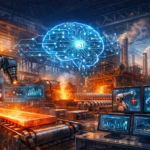
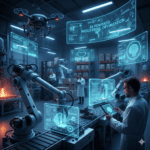
In 2026, artificial intelligence in the steel industry has become one of the fundamental pillars of digital transformation in steel plants. Digital steel factories leverage AI to manage quality control, equipment maintenance, energy consumption, and industrial decision-making in a smart, data-driven manner.
The objective is no longer limited to automation or monitoring. Instead, the focus has shifted toward continuous optimization, learning from production-line experience, and real-time decision-making at industrial scale.
Dorsa, with its strong focus on industrial artificial intelligence, advanced machine vision, and seamless integration of AI with control systems, plays an active role in driving this digital transformation.
Artificial intelligence in the steel industry enables scrap reduction, productivity improvement, and the transition toward smart steel production.
This article adopts a modern, future-oriented perspective aligned with global 2026 trends, exploring real-world and next-generation applications of AI in the steel industry.
In next-generation steel plants, artificial intelligence:
Does not merely analyze data, but actively proposes executable decisions
Interacts directly with PLC systems and Level 2 and Level 3 architectures
Learns production-line behavior under varying operating conditions
Enables automated and adaptive process optimization
This transformation marks the steel industry’s entry into the era of Smart & Self-Optimizing Plants.
In 2026, quality control is no longer limited to visual defect detection. Modern approaches include:
Fusion of image data, process parameters, and production history
Root Cause Analysis of defects
Prediction of defects before they appear on the product surface
Dorsa’s AI solutions transform quality control from a reactive process into a preventive and learning-based system.
📌 Result: Reduced scrap, improved quality consistency, and more accurate decision-making
One of the most significant global trends is the use of AI as a decision-support brain for control systems, enabling:
Adaptive adjustment of rolling parameters
Intelligent response to raw material quality variations
Real-time correction of speed, temperature, and pressure
In this architecture, PLCs remain responsible for execution and safety, while AI recommends the optimal control decisions.
Modern predictive maintenance goes beyond fault alarms and includes:
Prediction of the optimal maintenance timing
Selection of the most cost-effective production stop scenario
Synchronization with production schedules and customer orders
AI answers the key question:
“When should maintenance be performed, and at what cost?”
📉 Reduced unplanned downtime
📈 Increased equipment reliability
In 2026, green steel has become a critical competitive advantage. AI plays a central role by enabling:
Real-time calculation of the carbon footprint of each coil
Optimization of energy and fuel consumption
Support for ESG reporting and export compliance requirements
AI makes steel production measurable, optimizable, and environmentally reportable.
In modern architectures, supply chain and production are no longer isolated:
Actual production quality → refined demand forecasting
Raw material delays → adaptive production strategies
Market data → dynamic production scheduling
The result is a smart ecosystem, spanning from mining operations to the final steel product.
Contrary to common belief, the main challenge of AI in the steel industry is not algorithms, but rather:
Industrial data quality and integration
Synchronization between vision systems and PLC data
Industrial-grade software architecture
Trust of operators and plant management
This is where the industrial and operational experience of companies like Dorsa creates a real competitive advantage.
The future direction of the steel industry points toward plants that:
Learn from their own operational experience
Reproduce successful decision patterns
Eliminate recurring production errors
In this journey, artificial intelligence becomes the collective memory and intelligence of the factory.
In 2026, artificial intelligence in the steel industry is no longer a technological option—it is a competitive necessity. Companies that implement AI deeply, industrially, and in an integrated manner—such as Dorsa—will achieve lower costs, higher quality, and greater market share.
For further insights into global trends in artificial intelligence in the steel industry, international reports published by the World Steel Association and McKinsey & Company serve as reliable references for steel industry managers and engineers.